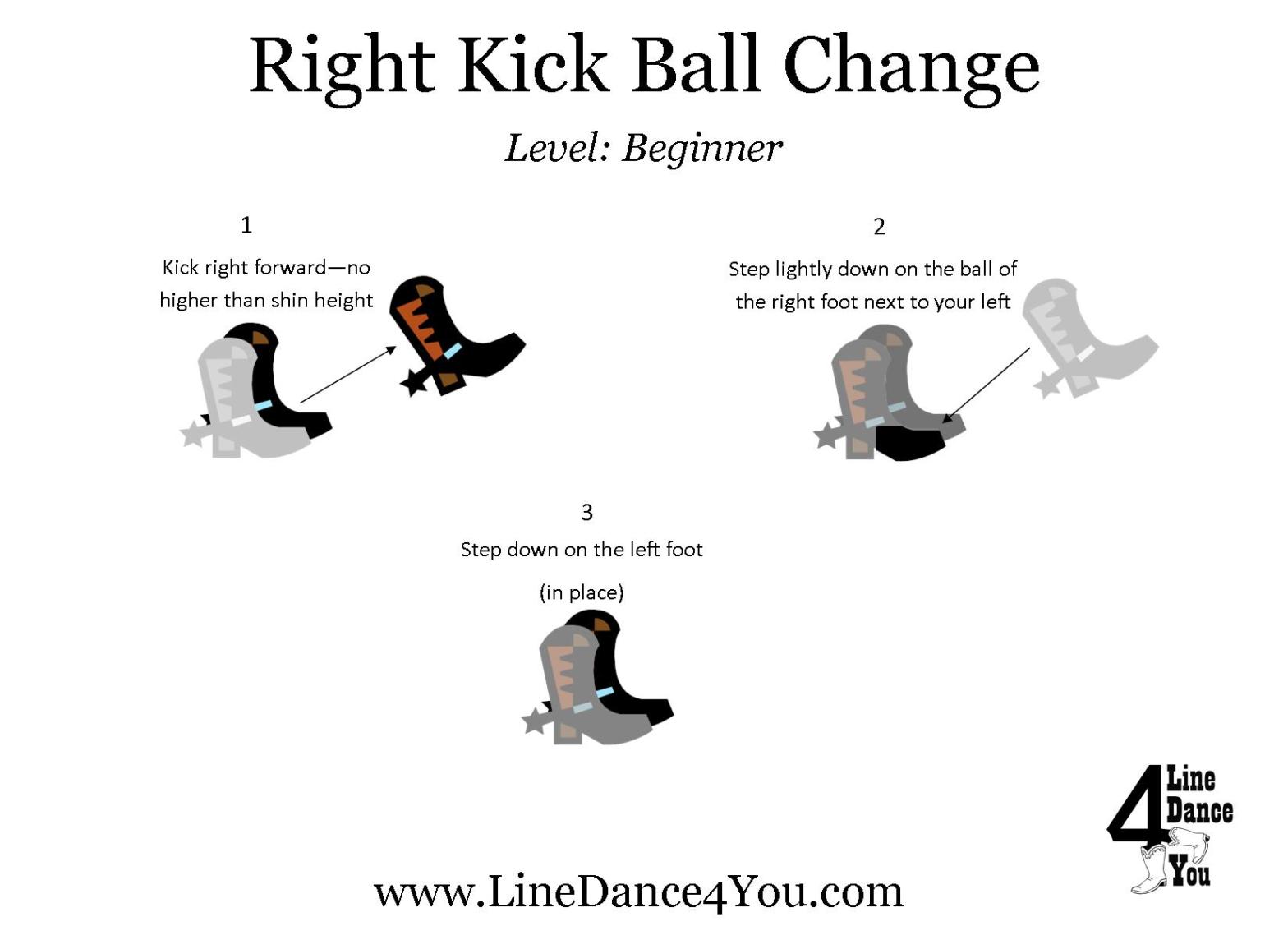
Directions: Kick foot forward, step down on ball of same foot, step down on other foot Example: Kick right foot forward, step down on right ball of foot, step down on left foot
Tips for this move: This dance is predominately done as a right KBC, but can be done with your left just as easily. Keep your kick low – no higher than your other shin. Be sure to be light on feet as with any move with a half step. For the second step (the “&”), you will just be on the ball of your foot for a split second.
Directions: Step foot A to side A(1), step foot B behind foot A (2), step foot A down next to foot B (&), tap heel of foot B to B front corner (3), step foot B down by foot A (&), cross foot A over foot B (4) with weight forward on foot A. Example: Step right foot to right (1), step left foot behind right foot (2), step right foot down next to left foot (&), tap heel of left foot to left front corner (3), step left foot down by right foot (&), cross right foot over left foot (4) with weight forward on right foot.
Tips for this move: For the final steps (&3&4), you will make a tick-tocking motion where your weight should be primarily on your right foot. If you rock your upper body back when doing step 3, then lean forward on step 4, it will help you maintain weight on your right foot, only using your left toe to as a lever to move your right foot from back to front.
This is a faster step than most, so make sure you pay attention to where your weight should be at all times, especially on the final step where your weight shifts to the front foot. Be light on your feet though, because you’re essentially squeezing 6 moves into 4 counts.
I’m sure you’ve heard the lyrics by now to Blake Shelton’s latest tune, “Boys ‘round here” where he sings “[You don’t do the Dougie?] Naw, not in Kentucky.” Well like most of you, I didn’t know what he was talking about either! It turns out that “the Dougie” which derived it’s name from late 80’s rapper, Doug E Fresh1, is one of the latest new dances out there and apparently it’s been around for a while (who knew?!). However, like many pop culture dances that come out, I’m often asked to teach it. But I only teach line dancing, so can I really teach this? I’ll have to put it to the test.
So what is line dancing technically? Webster’s Dictionary provides a pretty limited definition of line dancing, so I defer to Wikipedia which encompasses more detail and cultural influences for the definition. According to Wikipedia, “A line dance is a choreographed dance with a repeated sequence of steps in which a group of people dance in one or more lines or rows without regard for the gender of the individuals, all facing either each other or in the same direction, and executing the steps at the same time. Line dancers are not in physical contact with each other. Older “line dances” have lines in which the dancers face each other (ie: Tricky, Tricky), or the “line” is a circle (ie: 16 Step or Structured Couples dances), or all dancers in the “line” follow a leader around the dance floor; while holding the hand of the dancers beside them.”2 The last sentence isn’t a constant of line dancing now, so we’ll focus on the earlier parts of the definition.
Ok, so now that we know how to define line dancing, let’s put these new dances to the test!
The Dougie
Cupid Shuffle
Harlem Shake
Cha Cha Slide
Gagnum Style
Wobble
Repeated Sequence for whole song
No standardized sequence
32 count 4 wall
No
Yes, but with tags
For chorus, but not remainder
32 count 4 wall
One+ lines
No
Yes
No
Yes
Yes
Yes
Same Direction
No wall change
Yes
No
Yes
Yes
Yes
Same Timing
Yes
Yes
Yes
Yes
Yes
Yes
Is it a Line Dance??
NO
YES!
NO
YES!*
NO
YES!
*The Cha Cha Slide is tricky because it has multiple tags, but it qualifies!
So since some of these popular dances are not actually line dances by definition, you will not find them in my line up. However, for those interested in learning them, here is some info and links to help you along:
The Dougie generally consists of shimmying and then gliding one’s hand through one’s hair. Each person who does the dance tends to add his own flair to the standard, and those variations help distinguish the Dougie from previous dance phenomena. 1 No Dougie, after all, looks quite the same.3
Gangnam Style is a freestyle dance developed by South Korean musician Psy to his song of the same name. Although it is freestyle though most of the song, it has a standard choreography during the chorus made up of 5 primary moves: gallop, lasso, leg sweep, chest pop and pose.
Harlem Shake, originally called the albee, is commonly associated with a similar dance move called ‘The Chicken Noodle Soup’. It mainly involves upper body movements and, according to the choreographer, Al B, it “comes from the ancient Egyptians and describes it as what the mummies used to do. Because they were all wrapped up, they couldn’t really move, all they could do was shake.” 4
Note that this should not be confused with the Harlem Shake videos
5. They are an Internet meme in the form of a video in which a group of people perform a comedy sketch accompanied by a short excerpt from the song “Harlem Shake”. The videos usually last about 30 seconds and feature part of the 2012 song “Harlem Shake” by American electronic musician Baauer. Baauer’s song starts with a 15 seconds intro, a bass drop, then 15 seconds with the bass, and a lion roar at the end of the first 30 seconds. Usually, a video begins with one person (often helmeted or masked) dancing to the song alone for 15 seconds, surrounded by other people not paying attention or seemingly unaware of the dancing individual. When the bass drops, the video cuts to the entire crowd doing a crazy convulsive dance for the rest of the video, often wearing either a minimum of clothes or crazy outfits or costumes while wielding strange props.
Since the Cupid Shuffle, Wobble & Cha Cha slide are all in fact line dances, we have step sheets for these dances. Note that the Cha Cha slide is unique in that it has many tags throughout the song and you typically follow along to the words of the song (think hokey pokey for lack of a better example).
No matter what style of dance you choose to do, go out and have fun with it! If it’s not perfect and if it’s not actually a line dance… WHO CARES as long as you’ve got your most important dancing asset to show for it… a smile.
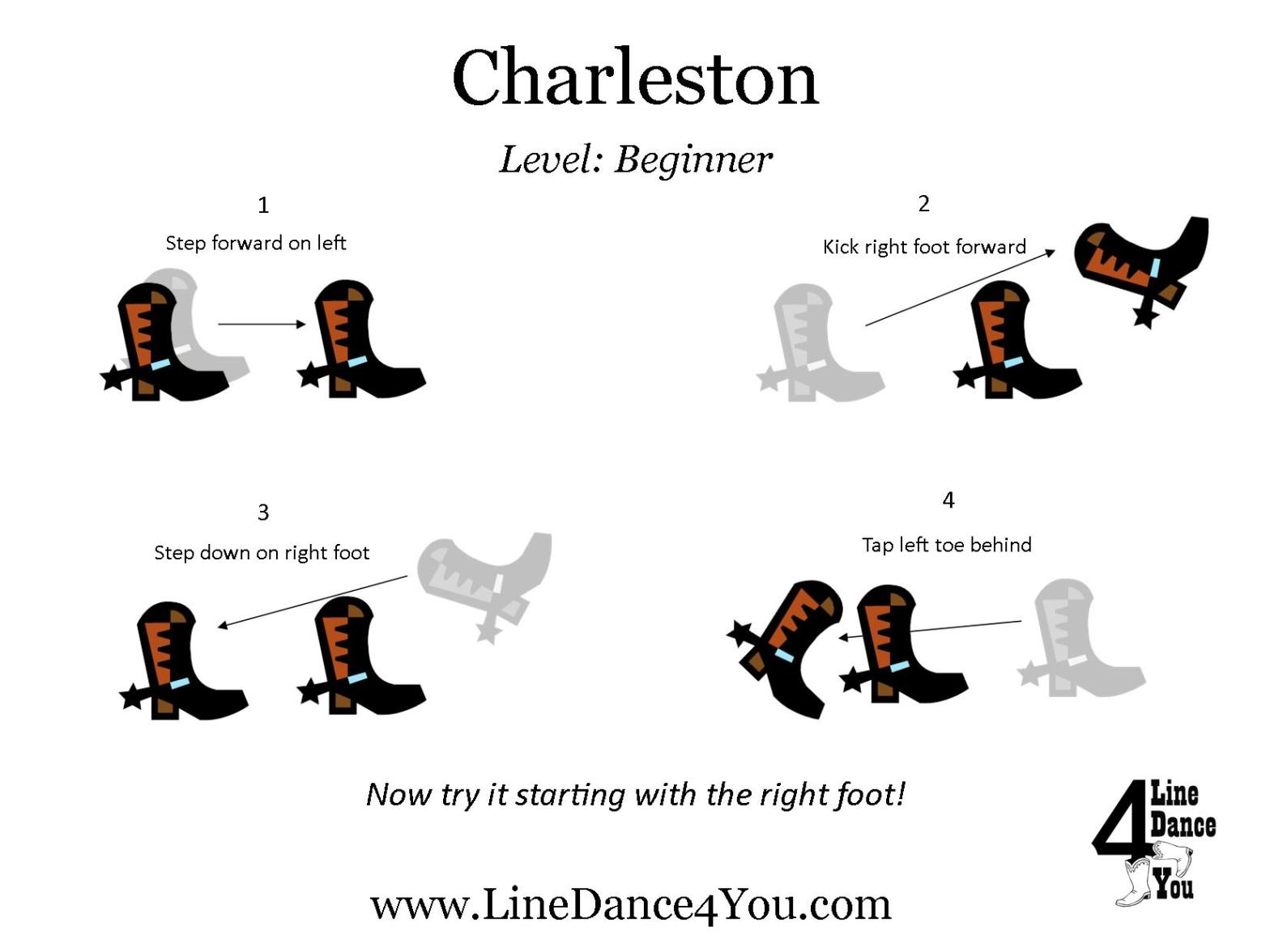
Directions: Step forward on foot A, kick foot B forward, step down on foot B (next to foot A), tap toe of foot A behind. Example: Step forward on right, kick left foot forward, step down on left, tap right toe backward
Tips for this move: On step #4, make sure you don’t put your weight down on foot A. This should just be a tap, so the weight stays on foot B. You only put weight down on steps 1&3.
Asking “What are line dance levels?” feels a wee bit silly doesn’t it? I know that I felt a little strange asking the question. I mean, after all, the whole idea of “Beginner – Intermediate – Advanced” is a concept that most of us “get” right away.
It isn’t a silly question, of course.
Even though most of us can easily grasp the concept of a ranking system which starts with…
…“so easy a baby could do it…”
…moves through “kinda in the middle someplace”…
…and ends up at “you have GOT to be kidding me!”
…it is not easy to figure out exactly which dance goes where. It is quite a mess in fact! No wonder folks get confused!
Fear not fellow dancer, by the end of this short article you’ll be able to skim the workshop list at a dance…
Directions: Step slightly forward with foot A, slide foot B so toe is lined with the instep of foot A, step slightly forward with foot A. (Reverse: Step back with foot A, slide heel of foot B in line with instep of foot A, step slightly back with foot A).
Tips for this move: Take TINY steps! This is a shuffle, not a sprint, so you’re taking tiny steps (think of an old man shuffling down a hall).
Notes: Chasse and shuffle are often used synonymously, but the primary difference is a shuffle moves forward/backward and a chasse moves right/left. Shuffles specifically are one of the most common dance steps, so you’ll see it in most dances. The ones listed above are just a small sample.
Directions: With weight on left, tap right to right side (1), turn ½ turn (or 1/4 turn) right, stepping down on the right foot (2), tap left toe to left side (3), step left foot down next to right (4)
Tips for this move: Push off slightly with your right foot to turn to the right (turning toward your back). For practice, try just tapping side to side (tap right, together, tap left, together) to get used to placing your weight on the right foot, then add the 1/2 or 1/4 turn on the second count once you feel comfortable.
One of the biggest challenges I find with new dancers is either they have trouble finding the beat of a song or they have trouble keeping that beat once they’ve found it. This is a great video that helps explain how to find that beat and ultimately how to keep it.
I would add that in line dancing, you need to keep light on your feet if you want to STAY on the beat. Oftentimes, people fall off the beat because they are too heavy footed (see “Carry Your Own Weight“), but if you keep light on your feet and listen to the beat, you’ll do great!
For those that have been dancing with us since the beginning, you probably were witness to many very famous acts that came and performed at our venue, Ned Devine’s (Sterling) back then. Some of the performers included Jason Michael Carroll, Tracy Byrd, Rascal Flatts, and many more including one in particular that has scarred me for life… Taylor Swift.
Let me set the stage for you (no pun intended). Taylor had just released her first song, “Tim McGraw” and had opening for her, Jason Michael Carroll. No one really new Jason at the time, but when he walked out onto the stage with his 1990’s rocker-like long hair, nobody was really paying attention, but as soon as he opened his mouth, man did things change! He literally shut the place up with his voice and we were in awe. Once Jason wrapped up though, this young girl came out onto the stage with her guitar and started singing what could only be considered average after listening to Jason (poor pairing in my opinion by the tour manager).
However, it wasn’t her average singing voice that really turned me and so many people off of her that day. It was that she was in a bar where everyone there had to be 21 or older to enter and she was singing about meeting a boy at a locker (I don’t think this song ever made it to a recording, thank goodness), her first kiss and other teenybopper topics that we all had long since put behind us (and most of us would rather not relive). To me, it was the equivalent of bringing Miley Cyrus into a biker bar… it just wasn’t a fit. It was a case of not knowing your audience and I blame her tour manager for this more than her, but it still set me off on an anti-Taylor music crusade.
People will also comment that her skills as a guitarist and songwriter also make her so “talented”. Again, I disagree. On the guitar, she can pluck a few cords, but nothing to the likes of Brad Paisley or even Keith Urban (check out this cool video of them jamming on the GOO with some other famous names). Plus, being able to play a guitar in country music is almost a rite of passage, so meeting that skill set just puts her at par with others. And as for her writing skills… well, for the pre-teens and teenagers out there, it’s probably fantastic, but outside of this targeted audience, it’s hit or miss as to whether people think it’s any good (I think you know my opinion by now).
So, as I watched her climb the charts, I was just baffled and a little annoyed that people, like the aforementioned Jason Michael Carroll who, in my opinion, had far more talent and relatable subject matter, just sputtered. I thought it was a complete marketing gimmick and therefore boycotted her music, not only in my class, but on my own radio (I’d just turn it off when I heard her in a form of protest).
My feelings toward her started to soften over the past few years as I couldn’t help but admit that, although I still felt her talent was just average, she was an excellent role model for teenage girls. While flipping through my guilty pleasure of Us Weekly, I would regularly see her doing good deeds and standing up for herself and others. She refused to go the trampy ways of Miley Cyrus or Britney Spears and was true to herself. She hasn’t gotten crazy tattoos, doesn’t wear trashy clothes and is never seen out partying it up. She’s truly a “good girl” and even though she has finally moved into her 20s and is starting to develop more mature lyrics, she knows who her target audience is (young girls) and maintains an image that they can follow.
So, while I likely will never be caught buying a Taylor Swift album, I do truly respect her and am glad that she has found the niche that has launched her to a platform where she can really do good in the world. I have even succumbed to listening to her songs when they come on the radio and sometimes find myself singing along (I’ll admit she is getting better as she gets older). As long as I don’t have to relive my own awkward teenage years when the music comes on and she continues to be the sweet, kind person she is, she will have my full support and who knows… maybe one day, we’ll even dance to one of her songs.
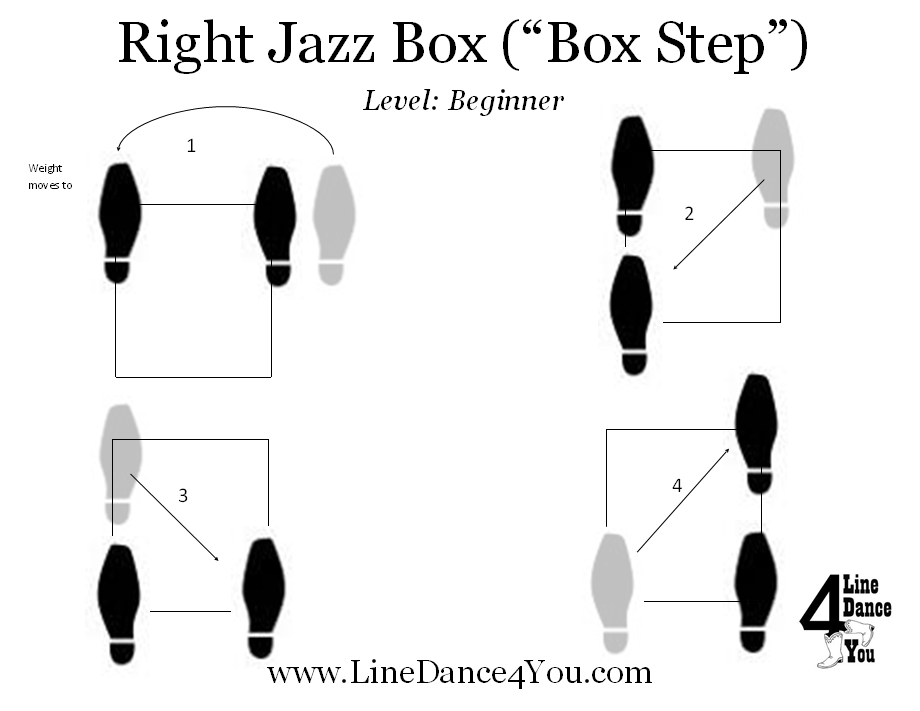
Directions: Cross/step foot A over foot B (weight moves from B to A), step backward on foot B, step foot A to the A side, step forward on foot B (back to original position). Example: cross right over left, step backward on left, step right to right side, step forward on left
Tips for this move: Picture a box on the floor where your left foot (this is for a right box step) is in the top left corner, then alternating R-L-R, move counter clockwise around the box stepping on each corner. Your legs will look “tangled up” at first, but you’re doing it right!



 LineDance4You