Step of the Week: Turning Jazz Box (or Turning Box Step)

Level:
Improver

Step count:
4 steps/ 4 counts (1-2-3-4)

Directions:
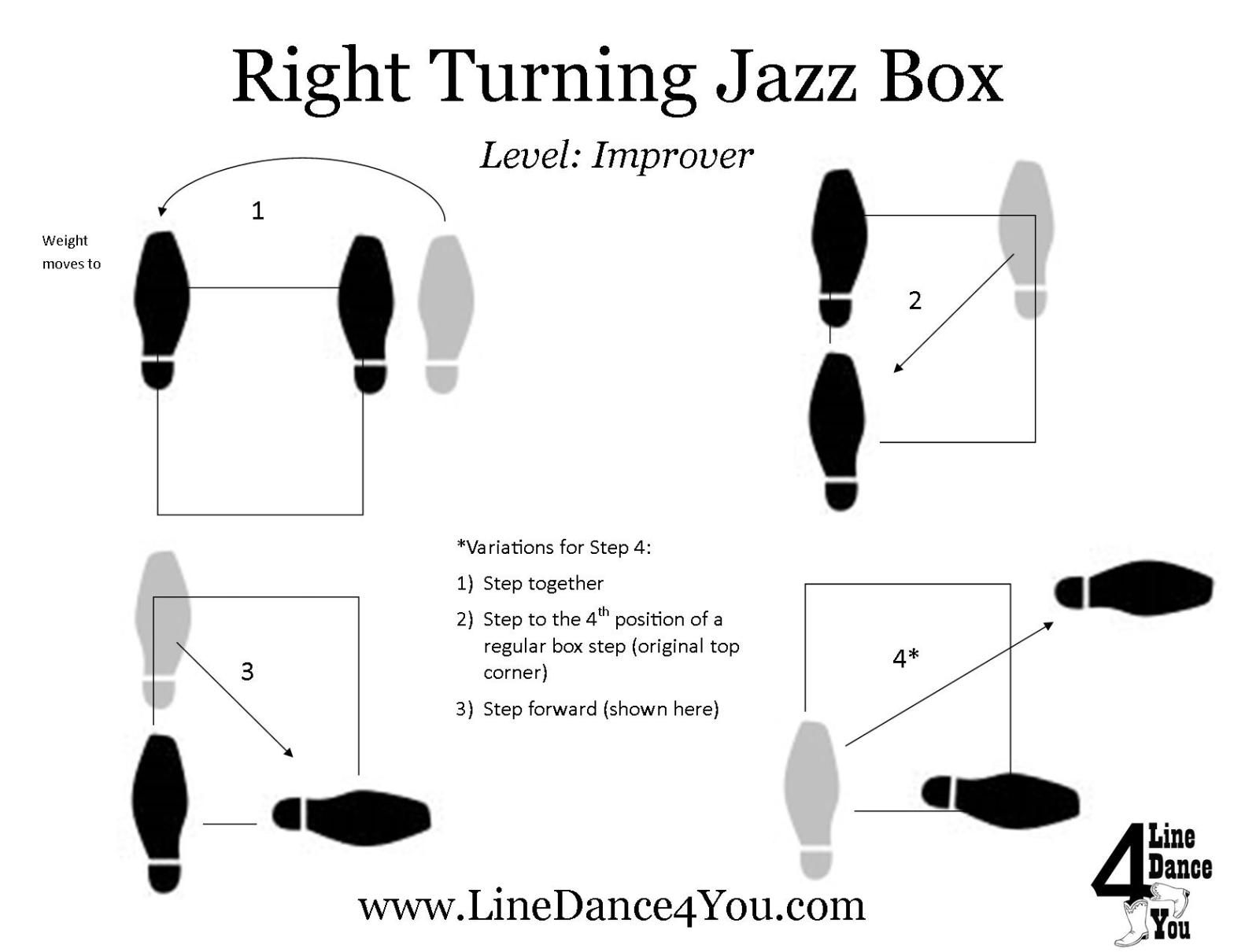
Cross/step foot A over foot B (weight moves from B to A), step backward on foot B, turn ¼ turn to direction A and step foot A forward, step forward on foot B*
Example: cross right over left, step backward on left, turn ¼ turn right stepping forward on right, step forward on left

Dances featuring this move:
Beers Ago, Ghost Train, Country Walkin’, Sittin’ Pretty, Before I Knew It, Push It, Beach Cowboy

Tips for this move:
Picture a box on the floor where your left foot (this is for a right box step) is in the top left corner, then alternating R-L-R, move counter clockwise around the box stepping on each corner. Only difference is that on step 3, you are turning ¼ turn right (for a right box).

*The 4th step has some variations: Some people do the 4th step as a step together or to the 4th position of a regular box step (original top corner), but we choose the step forward method to keep consistent with the 4th step of a standard jazz box.


Step of the Week: Heel Switches

Level:
Beginner

Step count:
4 steps / 2 counts (1&2&)

Directions:
Tap heel of foot A forward (1), step foot A next to foot B (&), tap heel of foot B forward (2), step foot B by foot A (&)
Example: Tap right heel forward (1), step right foot next to left foot (&), tap left heel forward (2), left foot by right foot (&)

Dances featuring this move:
Tush PushSittin’ Pretty, Party Like You, Askin’ Questions, Push It

Tips for this move:
What makes heel jacks unique is that for each tap of the heel, there is a corresponding step together on the upbeat. Since this move involves syncopated steps (half steps), you need to (1) move a little faster than a typical 1-2 step and (2) do not leave out that second & step (stepping together). Heel jacks are most often followed by a step turn and almost always started with the right foot, but that is subject to choreographer’s discretion.

Right Heel Jacks

Step of the Week: Weave

Level:
Beginner

Step count:
4 counts (1-2-3-4)

Directions:
Cross foot A over foot B, Step foot B to B side, cross foot A behind foot B, step foot B to B side. Weight ends on foot B.
Example: Cross/step Right over left, step left to left side, cross/step right behind left, step left to left. Weight ends on left foot.

Dances featuring this move:
DHSS, Ghost Train, Push It, Do Thy Neighbor

Tips for this move:
This is basically an “inside out” grapevine. Where you step away from your body for the first step of a grapevine, you start a weave by crossing OVER your other foot in a weave.


The hardest step in line dancing

We all know that line dancing is basically an amalgamation of different steps put together to match the tempo of a song (we all knew that, RIGHT?!?).  So, in the many years I’ve been teaching, I’ve taught a lot of different steps.

Some of the harder steps I’ve taught include wizard step, sailor step, scissor step, vaudeville step, basic steps with odd turns, cross chasse, etc.  However, I have finally nailed down the absolute hardest step that I’ve ever taught.  It is… wait for it…. the pause!

Literally, I’ve found that having to hold for a beat in a dance is the Achilles heel to most dances.  We are so used to making a move on every step (or even every half step) that the idea of just standing there for a beat is more than our bodies are willing to allow.  

The following are some of our dances that have pauses in them (how many have you mastered??):

The best way to combat the pause problem is to count steps (literally).  Pretty much all dances are done in 8 counts*, so as you’re doing the steps, count them off.  For example:

1-2-3-PAUSE-5-6-7-8

Keep in mind that there are a lot of half counts in our dances too though, but it will still have the same 8 counts, so it may be more like this, but you still get your 8 counts:

1&2-3-4-PAUSE-6-7&8

So next time a dance looks easy, take a “pause” and see if you can stop your momentum once you get going!  If not, come see me and we’ll work through that stinkin’ pause together!

*Disclaimer: In my experience, every line dance is done in 8 counts.  I have yet to come across one that isn’t, but since anyone can choreograph a dance and there are no rules, technically someone could break this pattern and some probably have, so that’s the only reason I say “pretty much all” instead of “all”.

Step of the Week: Lindy Step

Level:
Advanced

Step count:
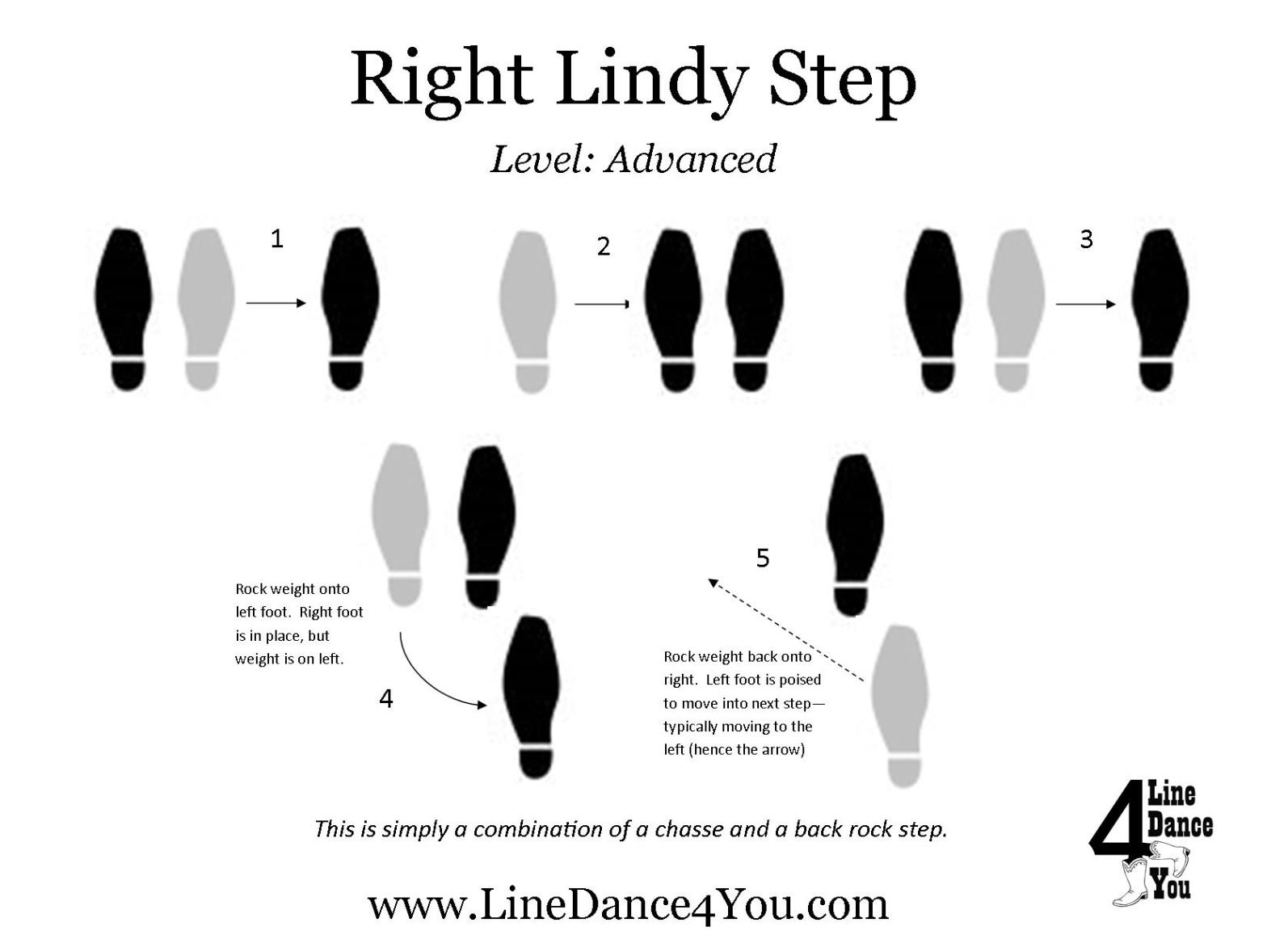
5 steps; 4½ counts (1&2-3-4)

Directions:
Step foot A to side A (1), step foot B next to foot A (&), step foot A to side A (2), step foot B behind foot A, rocking weight onto foot B (3), recover weight onto foot A (4)
Example: Step right to right (1), step left next to right (&), step right to right (2), step left behind right, rocking weight onto left (3), recover weight onto right (4)

Dances featuring this move:
Toes In the Water, I Love a Rainy Night, Beach Cowboy

Tips for this move:
This is simply a combination of a chasse and a back rock step.


The Evolution of Country Music

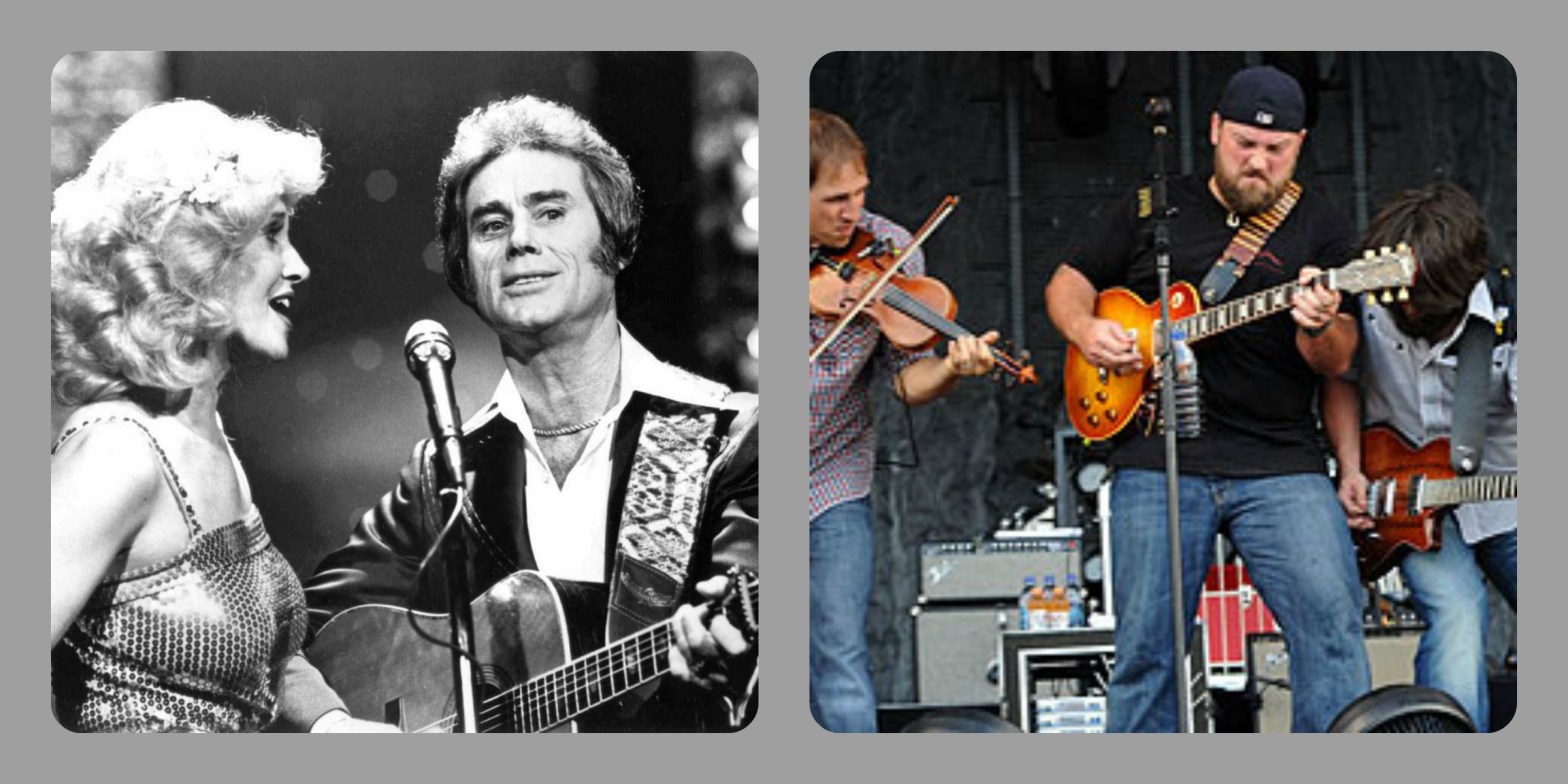
I am so happy to finally see the cultural shift that has put country music back in the mainstream category.  While some die hard “old country” fans (think: George Jones, Waylon Jennings, Patsy Cline, etc) complain that new country is to “pop-y” and isn’t truly country, I think it is a great transformation of the genre.

Think about it… 10 years ago, if someone asked you what kind of music you listen to, you’d likely have one definitive answer: country, rock, rap, etc.  However, ask somebody this question today and 99% of the time, you’ll get an answer along the lines of “I listen to a little bit of everything.”  This is great for our culture… it adds a little “Kumbayah” unity among us all no matter our background or style.

This is, of course, partly attributable to the increase in individual song selections from places like iTunes, where you no longer have to buy an entire album and commit to listen to the whole thing (since you did pay $20 for it after all).  Now, you can check out tunes from other genres and for $1.29, why not jam out to some song that you otherwise would not have found on your usual radio station?

Of course, the shift country musicians have made is the biggest factor.  Spearheading the path toward pop, singers like Taylor Swift and Carrie Underwood have added a new energy to their music.  Musicians like Jason Aldean and Big & Rich have introduced rap to the country music scene.  And my personal favorite (responsible for converting my “classic rock only” husband and “80’s/90’s only” brother) is Zac Brown Band who has meshed bluegrass, classic rock, ballads, country, pop and more into one beautiful conglomeration that leaves me unable to find a single person who doesn’t enjoy at least one ZBB tune.

The old stigma around country music of lyrics like “my dog just died and my wife is in the pen’, so I’ll go to the saloon and drink ‘till she’s pretty” are typically a thing of the past and have even been mocked by country music stars like Rascal Flatts (re: [When You Play A Country Song] “Backwards”).  Of course, there are still sad songs and goofy songs in country, but when you put it up to some mainstream tunes, like “Thrift Shop” by Macklemore and “Call Me Maybe” by Carly Rae Jepsen, I think country has finally gotten the upper hand in the lyrics department, so it has finally earned some long overdue respect.

How does this have anything to do with line dancing?  Well, duh…. Line dancing in America started out as “country western line dancing” done to “country western” music.  Well, lucky for us, as country western became just country and now has become this morphed form of upbeat tunes, line dancing has picked up the pace from very stiff and low impact moves to a high energy, high cardio, multi-faceted dance form that would make your aerobics instructor proud.  Previous articles about the caloric benefits of line dancing had it burning about 115-150 calories/hour.  In January, I wore a calorie counter for a few weeks to test this theory and found that we were burning more than 400 calories/hour!  If country music hadn’t picked up the tempo, we likely would not have picked up our pace and seen such a health (and fun) benefit.  It has made line dancing become a very popular dance form again!

We now line dance to all kinds of tunes from pop, rap and rock, but our heart is in country and thankfully country music is adapting to our new found appreciation for other genres.  So kudos to country music execs, artists and proprietors such as iTunes for growing with us and expanding our horizons!
Step of the Week: Chasse

Level:
Beginner

Step count:
2& counts (1&2)

Directions:
Step foot A to side A (1), step foot B next to foot A (&), step foot A to side A (2)
Example: Step right to right side, step left foot next to right (“step together”), step right to right side.

Dances featuring this move:
Askin’ Questions, Toes In the Water, West Coast Lover, I Love a Rainy Night, Swamp Thang, DHSS, Cowboy Casanova, Kick & Rock (aka: The Can-Can)

Tips for this move:
Chasse and shuffle are often used synonymously, but the basic difference is a shuffle moves forward/backward and a chasse moves right/left. Unlike with shuffles, you can make larger steps in a chasse, but keep in mind that because there is still a half-step in this move, you will need to be light on your feet – you are squeezing 3 steps into 2 beats – so stay on your toes (it’s ok to flat foot the last step though).


Step of the Week: Stutter Steps

Level:
Improver

Step count:
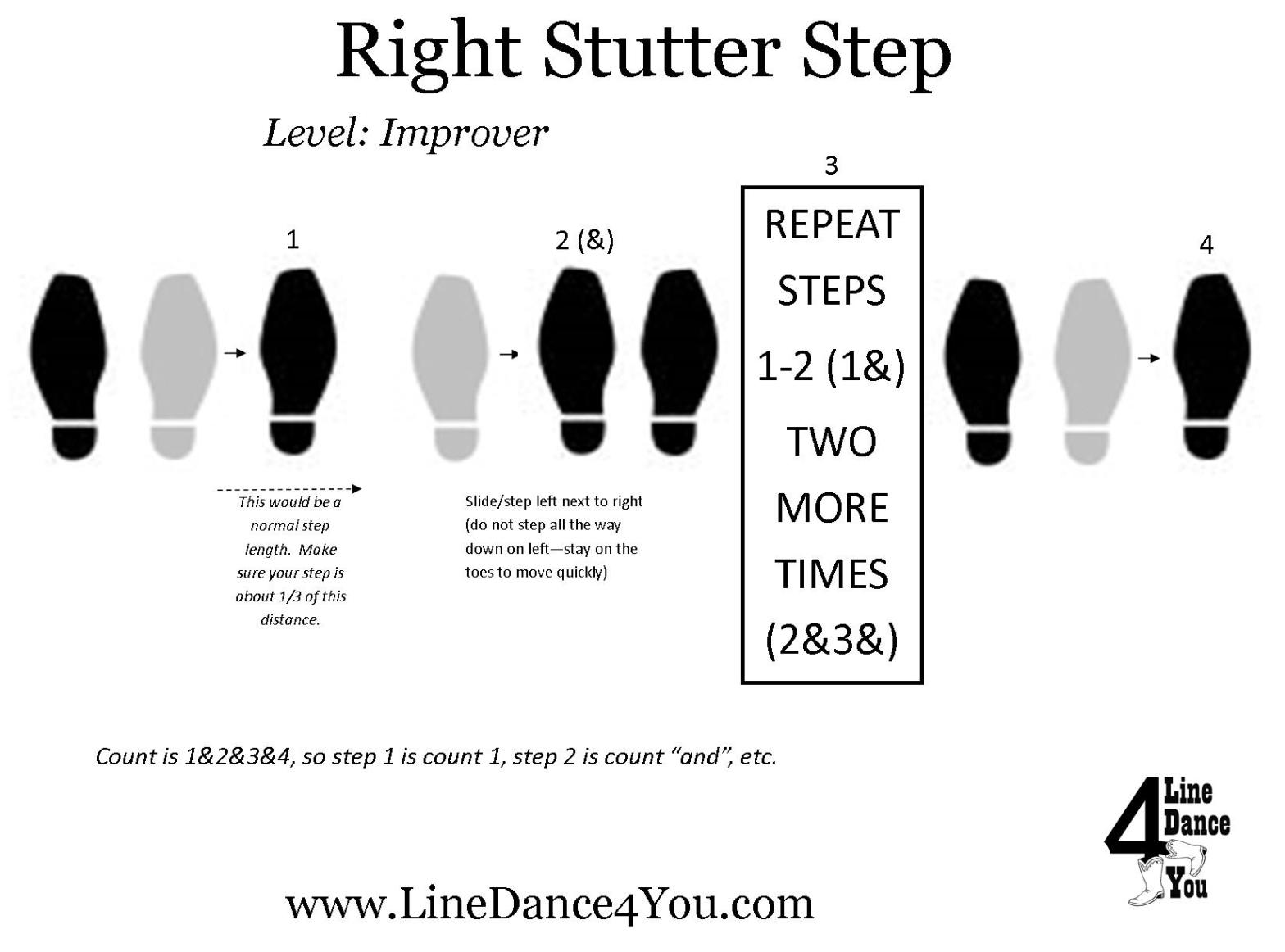
7 steps / 4 counts (1&2&3&4)

Directions:
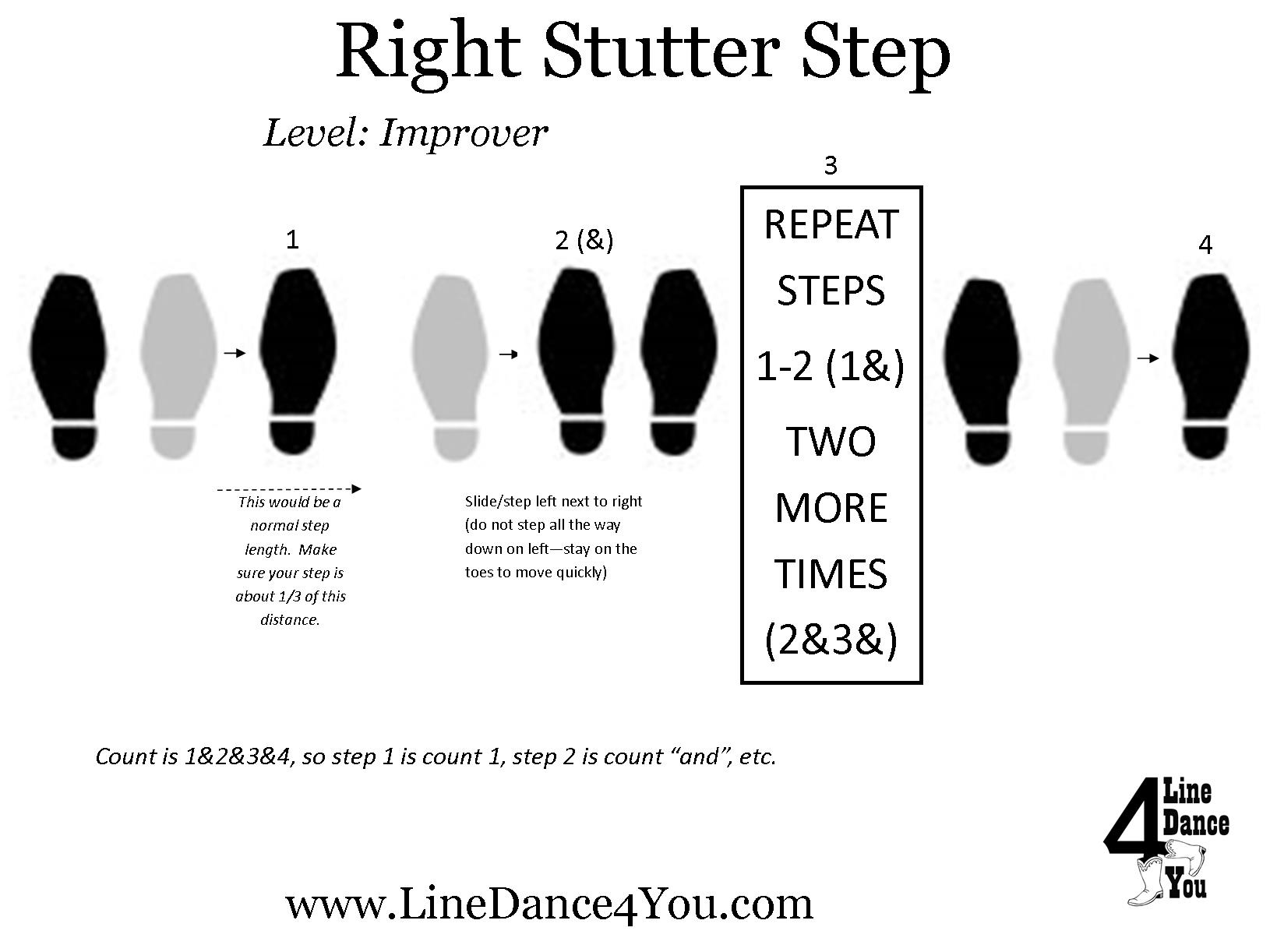
Step foot A SLIGHTLY to side A(1), drag and step foot B next to step A(&), repeat 2 more times(2&3&), then step foot A SLIGHTLY to side A one more time (4) (do not drag/step foot B)
Example: Step slightly right, step left foot together by right, step slightly right, step left foot together by right, step slightly right, step left foot together by right, step slightly right.

Dances featuring this move:
Hunt You Down, Mambo Shuffle (Steps 25-32 are diagonal stutter steps although not properly named in the step sheet)

Tips for this move:
The key to stutter steps is to take TINY steps and drag your other foot after the first. Be sure not to step down on the foot B on the final step (4). Again, because there are half steps involved, be sure to stay on your toes to move quickly. No flat footin’!

Stutter Step

Baby Steps

Each week, I post a new step of the week so dancers can expand their line dancing repertoire.  However, as I watch my dancers tackle new moves each week, I always notice little idiosyncrasies that don’t always convey in written instruction (see: “Carry Your Own Weight” for one example). 

Well this week, I noticed one of the other plagues of new dancers… the big steps!  Many times, when someone is starting out, they often exaggerate moves.  However, because you often need to move quickly whether in a particular step or just transitioning from one step to another, you need to actually take SMALLER steps than you normally would. 

The step where this error most commonly occurs is the grapevine.  The step, which entails stepping away, crossing behind, stepping away again and tapping, often leads to what I like to call, “the line dance straddle”.  People inherently try to take WIDE steps out and when they do, they can’t get their balance properly and can’t move quickly enough to the cross behind.

So as you’re learning new steps or new dances, keep in mind that side-to-side steps should be no wider than your hip-width and forward/back movements should be about the length of a normal walking stride.  Unless you’re trying to avoid a crack (and thus, break your mother’s back), you typically don’t reach every time you step forward, so do the same for dancing… and we’ll try to keep the cracks off the floor so Mama’s safe.  😉


Step of the Week: Coaster Step

Level:
Improver

Step count:
2 syncopated counts (1&2)

Directions:
Step back on foot A (1), step foot B back (beside foot A)(&), step forward on foot A (2)
Example: Step back on right, step left back together with right, step forward on right

Dances featuring this move:
Sha La La, Country Walkin’, High Heels On the Beach 

Tips for this move:
Keep light on your feet for the first two steps (1&). Triple step is often used as a beginner’s substitute for this move.